
About Our Services
The Cornea: The Window of Your Eye
What is the Cornea?
What is the Cornea?
How Does It Work?
The cornea is the eye’s most powerful focusing element. While many people think the internal “lens” does all the work, the cornea is actually responsible for 65% to 75% of the eye’s total focusing power.
Refraction: When light hits the curved shape of the cornea, it bends (refracts) the incoming light.
Focus: This bending helps focus the light directly onto the lens and then the retina at the back of the eye, creating the clear images you see.
The Anatomy: 5 Layers of Strength
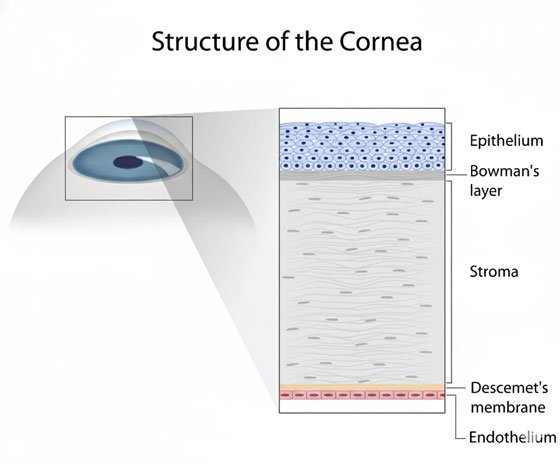
Although the cornea is clear and looks simple, it is a highly complex tissue composed of five distinct layers:
Epithelium: The outermost layer. It functions like skin, blocking the passage of dust, water, and bacteria. It heals very quickly from minor scratches.
Bowman’s Layer: A transparent sheet of tissue composed of strong protein fibers called collagen. If injured, this layer can form a scar.
Stroma: The thickest layer (about 90% of the cornea). It is made mostly of water and collagen. The collagen proteins are arranged in a perfect, uniform pattern, which is exactly what makes the cornea transparent.
Descemet’s Membrane: A thin but strong sheet of tissue that serves as a protective barrier against infection and injury.
Endothelium: The innermost layer. These specialized cells act as a pump, removing excess fluid from the cornea to keep it clear. If these cells are damaged, the cornea can swell and vision can become cloudy.
Why Is It Unique?
No Blood Vessels: The cornea is one of the few tissues in the human body that contains no blood vessels. To stay healthy, it absorbs oxygen directly from the air.
Extreme Sensitivity: The cornea has more nerve endings than almost anywhere else in the body. This is a defense mechanism; even a tiny speck of dust causes pain or blinking to protect your vision immediately.